


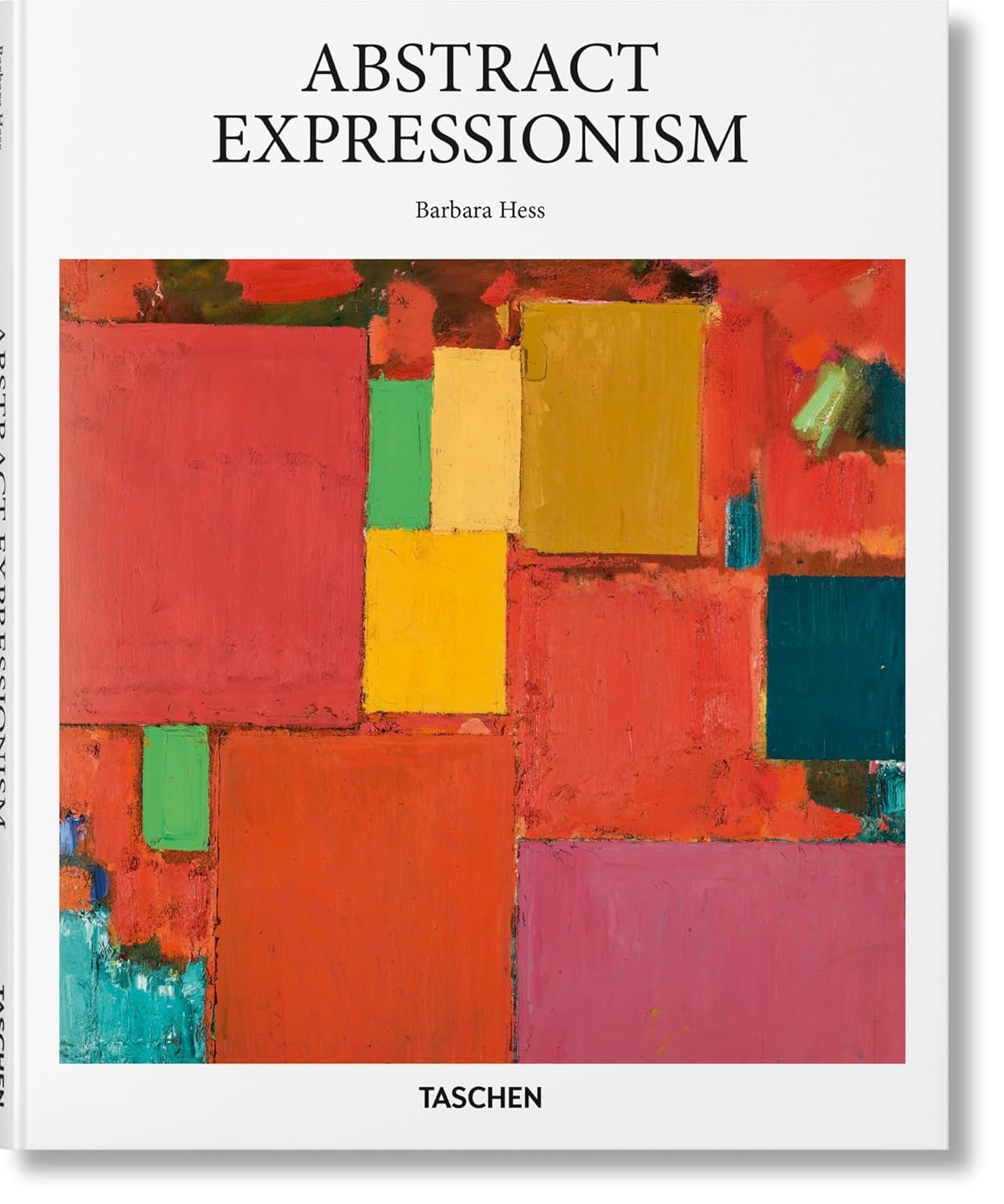


Hailed as the first American-born art movement to have a worldwide influence, Abstract Expressionism denotes the non-representational use of paint as a means of personal expression. It emerged in America in the 1940s, with lead protagonists including Jackson Pollock, Philip Guston, Robert Motherwell, Mark Rothko, and Willem de Kooning.
Abstract Expressionism spawned many different stylistic tendencies but two particularly prominent sub-categories: action painting, exemplified by de Kooning and Pollock, and color field painting, made most famous by Rothko. Throughout, Abstract Expressionists strove to convey emotions and ideas through the making of marks, through forms, textures, shades, and the particular quality of brushstrokes. The movement favored large-scale canvases, and embraced the role of accident or chance.
With featured works from 20 key Abstract Expressionist artists, this book introduces the movement which shifted the center of art gravity from Paris to New York and remains for many the golden moment of American art.
Publisher : TASCHEN
Publication date : January 15, 2016
Edition : Illustrated
Language : English
Print length : 95 pages
ISBN-10 : 3836505177
ISBN-13 : 978-3836505178
Item Weight : 2.31 pounds
Dimensions : 8.27 x 0.55 x 10.24 inches
Part of series : Basic Art
Best Sellers Rank: #114,759 in Books (See Top 100 in Books) #112 in Art Movements (Books) #411 in Art History (Books)
Customer Reviews: 4.7 4.7 out of 5 stars (313) var dpAcrHasRegisteredArcLinkClickAction; P.when(‘A’, ‘ready’).execute(function(A) { if (dpAcrHasRegisteredArcLinkClickAction !== true) { dpAcrHasRegisteredArcLinkClickAction = true; A.declarative( ‘acrLink-click-metrics’, ‘click’, { “allowLinkDefault”: true }, function (event) { if (window.ue) { ue.count(“acrLinkClickCount”, (ue.count(“acrLinkClickCount”) || 0) + 1); } } ); } }); P.when(‘A’, ‘cf’).execute(function(A) { A.declarative(‘acrStarsLink-click-metrics’, ‘click’, { “allowLinkDefault” : true }, function(event){ if(window.ue) { ue.count(“acrStarsLinkWithPopoverClickCount”, (ue.count(“acrStarsLinkWithPopoverClickCount”) || 0) + 1); } }); });



SueLG –
A helpful book about abstract expressionism!
This 96-page hardcover book addresses many artists of abstract expressionism with large colorful photos of their work and stories about each artist. It is concise, knowledgeable, and is a great addition to my art book collection.
P. Gruhn –
Excellent book! I love this series!
I have been slowly purchasing each book in this series .. a very condensed easy to read overview of the various topics. TONS of great pictures. 5-stars
Robert Morris –
Here is “a fast-food, high-energy fix on the topic at hand.” The New York Times
This is one of several dozen volumes in the Basic Art series published by Taschen. Barbara Hess focuses on 23 of those now known as “Abstract Expressionists” and/or “the first generation of the New York School.” Many referred to themselves as “the Erascibles.”Opinions are divided about the nature and extent of impact that abstract expressionism has had. Indeed, disagreements continue even now as to what the term means. Hess points out that the expression first turned up (in German) in an issue of Der Sturm magazine in 1919. I tend to agree with Willem de Kooning’s response, when Albert Barr (former director of New York’s Museum of Modern Art) demanded one: “It is disastrous to name ourselves.” Be that as it may, I praise everyone involved with the creation of this book on the high quality of its text, sources, organization, and production values. The mini-bios are remarkably substantial and the selection of individual works to complement them is superb. I also appreciate the observations provided by individual artists. For example:o “It is a widely accepted notion among painters that it does not matter what one paints as long as it is well painted. This is the essence of academicism. There is no such thing as good painting about nothing.” Mark Rothko (1903-1970)o “The stuff of thought is the seed of the artist. Dreams form the bristle of the artist’s brush.” Arshile Gorky (1904-1948)o “The ability to simplify means to eliminate the unnecessary so that the necessary may speak.” Hans Hofmann (1880-1966)o “I have no fears about making changes, destroying the image, etc., because the painting has a life of its own.” Jackson Pollock (1922-1956)o “There are as many images as there are eyes to see.” Sam Francis (1923-1994)o “Aesthetics is for the artists like ornithology is for the birds.” Barnett Newman (1905-1970)o “My favorite symbols were those which I did not understand.” Adolph Gottlieb (1903-1974)o “The thing is that a person who wants to explore painting naturally reflects: ‘how can I in my work be most expressive?’ Then the form develops.” Franz Kline (1910-1962)o “My painting is not an allegory, it is not a story. It is more like a poem.” Joan Mitchell (1926-1992)o “I take an elegy to be a funeral song for something one cared about. The [200+] Spanish Elegies are not ‘political’, but are my private insistence that that a terrible death happened that should not be forgot. They are as eloquent as I could make them. But the pictures are also general metaphors of the contrast between life and death and their interrelation.” Robert Motherwell (1915-1991)I commend Barbara Hess on her brilliant introduction. Its title, “A Constant Searching of Onerself,” is certainly true of the artists she discusses in this volume and I am among those who, when interacting with their works, also feel challenged and inspired to sustain our own journey for self-discovery.
glenn –
-An Impossible Topic Barely Covered-
Another thin Taschen book at only 95 pages that manages to convey the essence of Abstract Expressionism without going too deep. But you could also spend years just learning this much so it’s a bargain…!Terrific color pictures accompany each artist’s explanation of their art and the creation of a new method, technique or style. One method for finding your own path is to collect those things you really like until your vision is what you want to see. Then fill your notebooks with work until your expressions are individual. What is beautiful to you?
Elmo Jenkins –
Great gift idea
Pretty book to have on the table or office. Great prints of a lot of famous works. Very enjoyable to read the short paragraphs about the artists.
Roger Jaques –
Copy in excellent condition as described.
Prompt service. Excellent product as described. Recommend.
Kelli L – Legit Reviews Are Helpful! –
Great coffee table book
Great coffee table/display bookshelf book. Has all the popular names in it. Nice photos nice quality and good price
Amazon Customer –
I love the book!
Bought this to help my young kids learn more about this movement by trying to replicate and observe some of these paintings! The full-size page images along with a full page of explanation side-by-side make this book idea as a coffee table book as well as a very educational resource!High quality prints are very important and I felt that this book did a good job with that. I’m very happy with this purchase.
Cindy Park –
Very good!
Dariusz Wojtow –
Book is with colourful prints of works of art. I enjoyed it. Little to thin. Not enough photos.
Cliente de Amazon –
La impresión es de muy mala calidad. Si ya tienes otros libros de Expresionismo Abstracto este no te va a aportar nada ni en calidad de reproducciones ni en información. No gasten en este libro aunque sea muy económico.
Cliente amazon –
Excelent!!!
Giulia –
Ho trovato molto utile questo libro: è semplice, diretto, sintetico ma ricco di dettagli. Da una chiara spiegazione del movimento e del periodo storico in cui si sviluppa, trattando i maggiori esponenti del movimento. Credo che per un beginner sia il perfetto punto di inizio; per un esperto chiaramente, suggerirei altro.